Year 6 · Spring term · Ratio · Step 5
Year 6 Scale drawings worksheets
Use map and plan scales to find real and drawn lengths. Two free editable Word sheets with the same questions: one scaffolded, one not. The answers follow the questions in each file: the same sheet again with every answer in red.
Download the worksheets
Both sheets have exactly the same questions, so the whole class can be taught together. Print on A4 portrait: every page carries the sheet twice, side by side, so you can cut down the middle and two pupils each get a half to stick in their books. Every question sits in its own box and pupils write their answers in their book. The answers follow the questions in each file: the same sheet again with every answer in red. Both open in Word, Google Docs, Pages and LibreOffice, so you can change numbers, delete questions or add your own.
Scaffolded sheet
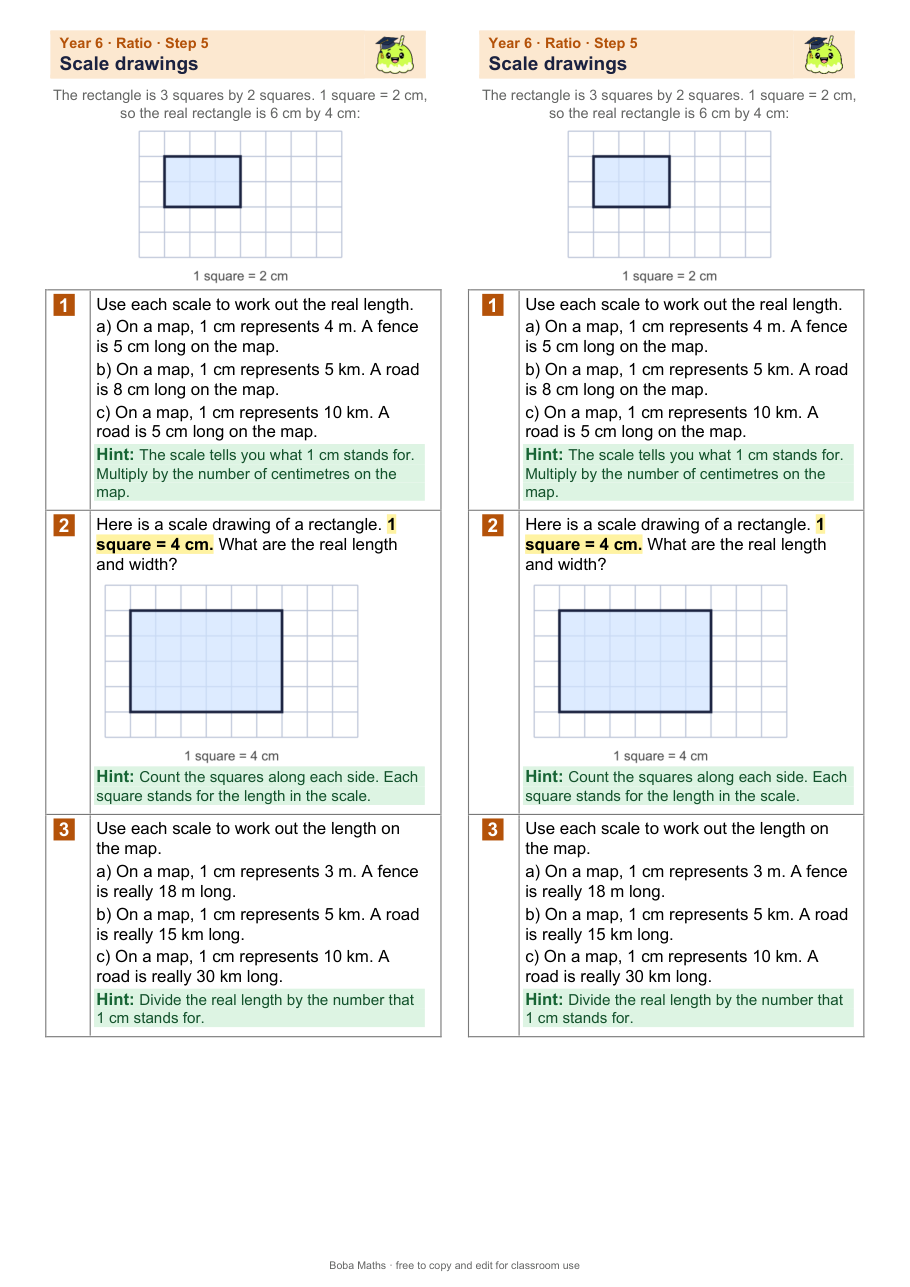
Key words highlighted, a hint under each question, and help charts or number lines. For pupils who are working towards the expected standard.
Not scaffolded sheet
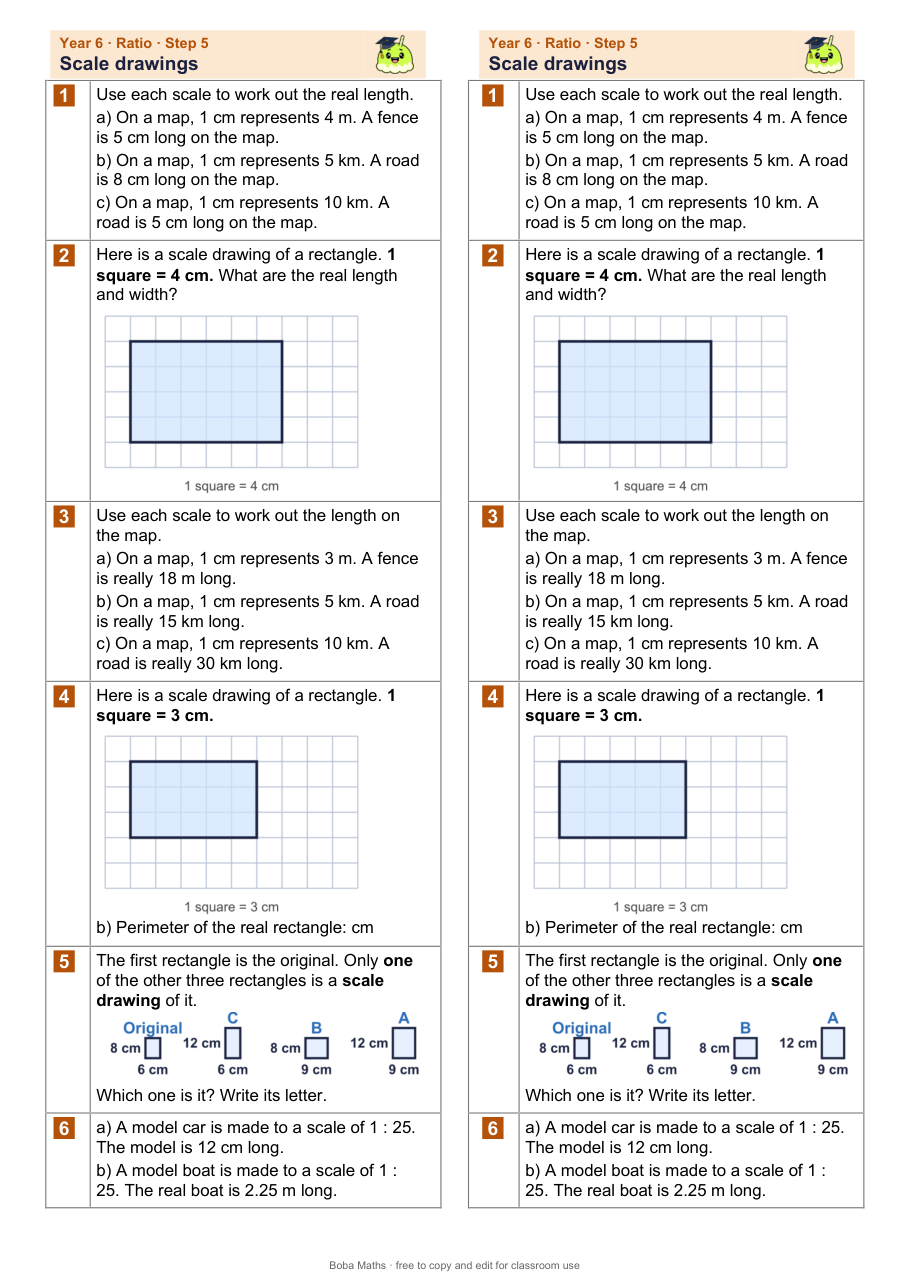
The same questions without the extra support. For pupils working at the expected standard: eight fluency questions first, then the reasoning questions.
Sample questions from this step
These are real questions from the first set of the sheet (two from the fluency page, two from the reasoning page). Open each one to see the answer.
- Use each scale to work out the real length.a) On a map, 1 cm represents 4 m. A fence is 5 cm long on the map.Real length: ____ mb) On a map, 1 cm represents 5 km. A road is 8 cm long on the map.Real length: ____ kmc) On a map, 1 cm represents 10 km. A road is 5 cm long on the map.Real length: ____ km
Show the answer
20; 40; 50
- Here is a scale drawing of a rectangle. 1 square = 3 cm.a) Perimeter of the drawing: ____ squaresb) Perimeter of the real rectangle: ____ cm
Show the answer
16; 48
- On a map, 1 cm represents 5 km.A river is 3 cm long on the map. So it is really 8 km, because 3 + 5 = 8.Is Boba correct? Circle yes or no.Circle yes or no.Explain the mistake.Real length: ____ km
Show the answer
No; Boba added. Each centimetre stands for 5 km, so 3 cm stands for 3 × 5 = 15 km.; 15
- On a map, 1 cm represents 250 m. Mia walks from A to B (9 cm on the map) and then from B to C (7 cm on the map).How far does Mia walk altogether? Give your answer in kilometres.____ km
Show the answer
4
What is on each sheet
- Fluency: eight questions that start easy and get harder, with the key skill of the step practised in different ways.
- Reasoning: questions with pictures, tables and number lines (spot the mistake, true or false and explain, puzzles with one answer, an open-ended task).
- Answers in the same file: the sheet again with every answer in red, so there is only one file to download.
- Boba characters give the instructions in speech bubbles. They are decoration only.
Why one set of questions?
- Everyone works on the same content, and support comes from scaffolds instead of different, easier tasks. This follows the mastery approach described by the NCETM and the thinking in Ofsted's 2021 mathematics research review.
- Worked examples and visual representations lighten the load for pupils who need it, as the Education Endowment Foundation describes.